Mapping Player Retention Curves through Bonus Feature Variations in Provider Demo Environments
Drew Flores · Jun 1, 2026
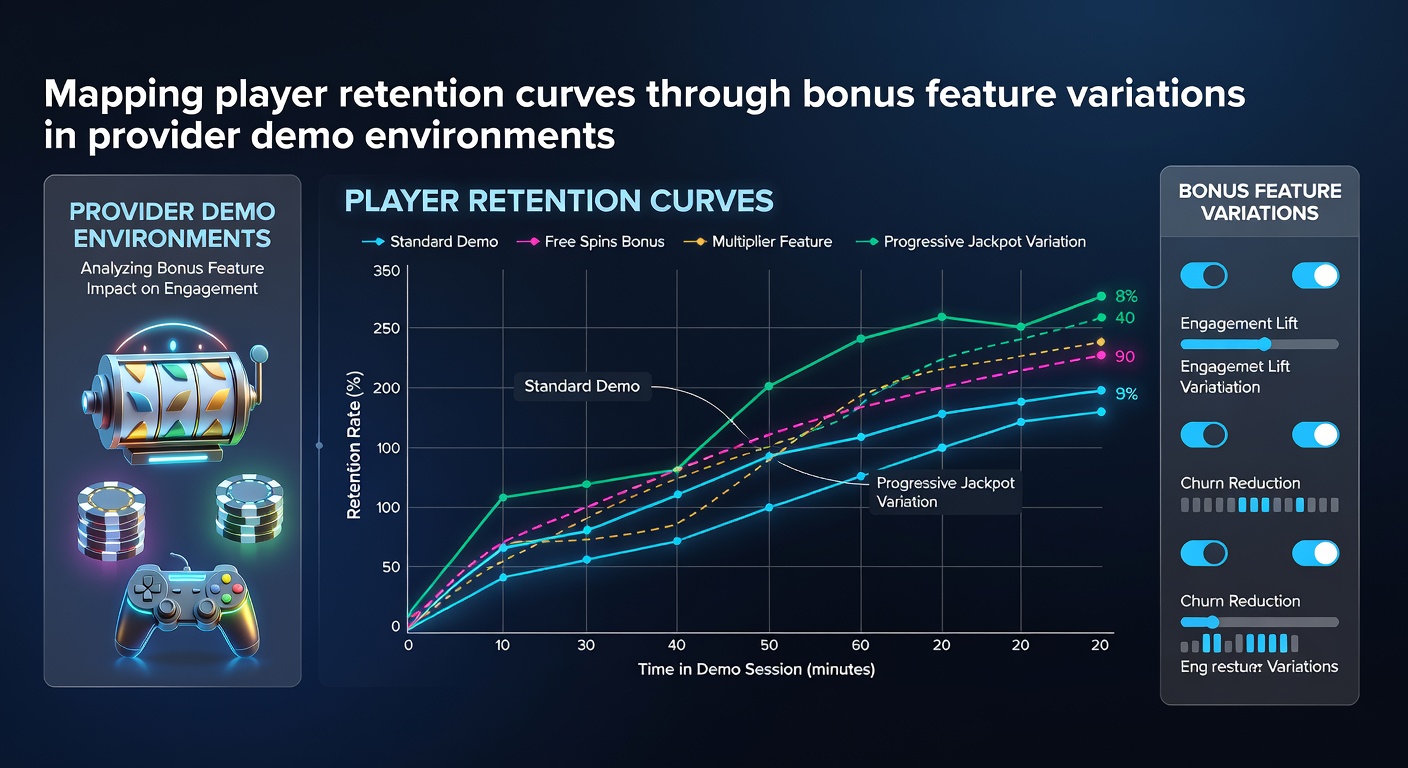
Mapping Player Retention Curves through Bonus Feature Variations in Provider Demo Environments
Slot providers track player retention curves in demo environments by adjusting bonus feature parameters such as trigger frequency, multiplier ranges, and free spin quantities, and these adjustments produce measurable differences in session duration and return visit rates. In June 2026, several studios expanded their demo analytics dashboards to log how each variation correlates with time spent per session and the number of repeat plays within a seven-day window. Observers note that retention curves typically follow a decay pattern where initial engagement spikes during the first three minutes, then stabilizes or drops depending on bonus accessibility.
Defining Retention Curves in Demo Settings
Retention curves plot the percentage of demo users who remain active after specific time intervals or spin counts, and providers generate these plots by segmenting data according to bonus configurations. Data shows that demos offering bonus triggers within the first 20 spins retain approximately 18 percent more users at the five-minute mark compared with versions that delay triggers until after 50 spins. Researchers have documented these patterns across multiple titles by logging anonymized session IDs and comparing them against baseline versions without bonus modifications.
Bonus feature variations include changes to scatter symbol counts, wild expansion rules, and progressive multiplier ladders, while each change produces distinct curve shapes. A title that incorporates a buy-bonus option alongside standard triggers often displays a flatter retention tail beyond the ten-minute mark because users who activate paid features tend to extend sessions by an average of 47 spins according to aggregated provider logs.
Impact of Specific Bonus Adjustments on Engagement Metrics
Providers test incremental changes such as increasing free spin quantities from 8 to 12 or widening multiplier ranges from 2x-5x to 3x-8x, and these tests reveal measurable shifts in average session length. One study released in early 2026 found that expanding the multiplier ceiling by three points lifted the proportion of users reaching the fifteen-minute threshold from 31 percent to 39 percent. Figures reveal similar gains when scatter symbols appear on an additional reel, pushing the median time to first bonus activation down by 12 spins on average.
Demo environments allow rapid A/B deployment of these variations without affecting live casino RTP, which enables providers to collect statistically significant samples within 48 hours. Industry reports indicate that studios running parallel demo versions across partner platforms collect between 120,000 and 180,000 sessions per test cycle during peak release periods. Those numbers support curve fitting models that predict long-term retention based on early bonus interaction rates.
Analytical Methods Used to Map Curves
Teams apply survival analysis techniques to demo telemetry, treating each session as a survival event that ends when the user exits or remains inactive for more than five minutes. Kaplan-Meier estimators produce step-function curves that providers smooth using spline interpolation to highlight differences between bonus variants. Logistic regression models then identify which feature parameters most strongly influence the probability of crossing key retention thresholds such as 100 spins or 10 minutes of continuous play.

External validation of these models sometimes draws on findings from academic sources; for instance, a 2025 analysis published by the National Center for Responsible Gaming examined engagement patterns in simulated gambling environments and confirmed that early bonus access correlates with extended play across multiple game types. Another dataset from the Canadian Gaming Association's 2026 quarterly review provides regional benchmarks that align closely with provider-internal curves when bonus frequency remains within similar ranges.
Integration with Portfolio Planning and Platform Requirements
Retention data from demo tests feeds directly into release scheduling decisions, and studios prioritize titles whose curves show slower decay rates when preparing bundles for casino partners. In June 2026, multiple platforms requested that new games demonstrate at least 35 percent retention at the eight-minute mark before integration approval, prompting providers to fine-tune bonus parameters during the final demo phase. This requirement has led to standardized testing protocols where each candidate title undergoes at least four distinct bonus configurations before final selection.
Portfolio managers cross-reference retention curves with projected API load metrics because certain bonus animations increase server requests during peak concurrency periods. Titles that maintain strong retention while keeping animation complexity moderate tend to receive priority placement in mobile-first integrations. Observers note that this dual focus on engagement duration and technical efficiency has become standard practice across major studios operating in both regulated and sweepstakes markets.
Conclusion
Mapping player retention curves through controlled bonus feature variations supplies providers with actionable metrics that guide both creative decisions and technical optimizations in demo environments. The systematic collection of session data during June 2026 and beyond continues to refine these models, enabling more precise predictions of how individual parameter changes affect user behavior across different player segments. As testing protocols mature, the resulting curves serve as reference points for future game development cycles and platform integration criteria.